Automation, shown rather than promised
Watch one ordinary handoff become a controlled workflow.
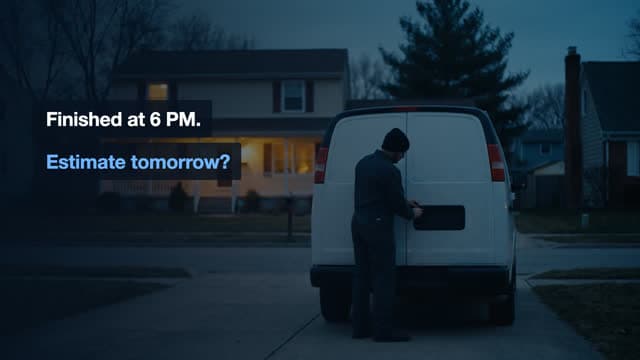
In 99 seconds: a technician records the site note, missing information is surfaced, an estimate is prepared, and the owner approves it before it reaches the customer.
Fictional company and synthetic data. Captions are on by default.
Automation & workflow systems
Reliable systems for the work that keeps returning.
Sirrius turns one recurring queue into software your team can inspect, control, and own. Start with a proven workflow or bring us one that is specific to your business.
Try the EstimateFlow dashboardA familiar day, with one less queue
See the handoff, not the technology.
This fictional HVAC example shows the kind of ordinary work Sirrius turns into a controlled system.
New enquiry
A customer asks for a furnace quote.
The request lands with the address, timing, and contact details in one place.
From site visit to customer-ready draft
See how we send a reviewed estimate the same day.
In this fictional HVAC example, a technician leaves a voice note, the system prepares the estimate, and the owner checks it before anything reaches the customer.
- Site notes captured
- Missing details flagged
- Price and scope reviewed by a person
The website is the front door
Beautiful enough to earn attention. Useful enough to start the work.
We can design the customer-facing experience and connect it to the workflow behind it. This fictional HVAC mockup shows how a service request can arrive complete, get routed, and become a reviewed estimate—not disappear into a generic contact inbox.
Fictional concept · no client identity or result impliedComfort without the runaround
Tell us what happened. We’ll prepare the next step.
Share the symptoms, timing, and a few details about your home. A person reviews every recommendation and estimate.
Service request
What happens next
Request arrives structured
Contact, timing, location, and symptoms are ready to review.
The right person gets it
Urgency and service area determine the queue—not whoever checks email first.
The estimate stays human
A technician adds the site note; an owner checks the scope and price.
What happens next
The issue is categorized
Plumbing, electrical, access, urgency, and permission details arrive together.
Urgent work is surfaced
A suspected active leak does not wait behind a paint-touch-up request.
The manager keeps control
The system prepares the vendor handoff; a person approves the action.
Home should feel handled
Maintenance help, without the phone-tree.
Tell us what you see, when we can enter, and whether the issue is getting worse. Your property manager reviews the next action.
Maintenance request
Proven starting points
One operational job per system.
Not sure where the workflow begins or ends?
A Workflow Blueprint maps the process, risks, approvals, and acceptance test before a complex build is priced.
One delivery model.
Map
Define the workflow, operating rules, risks, approvals, and the result the system must produce.
Build
Create and implement the client-owned system for a fixed scope and fixed price.
Run
Optionally monitor, maintain, and improve the system after it is working in the business.
Questions about installing one.
How much does one automation cost?
You get a fixed price before any development starts. The Skill Readiness Sprint is $750 flat and is credited in full toward your build. Setting one up starts at $1,800. Running it after launch is $350 per month per workflow, or $900 per month for up to three workflows as a single desk.
How long does it take to install one?
The Sprint is a single 90-minute session. A pilot configured on your own material typically runs a few weeks, followed by a 30-day stabilization period where we tune it against real cases. You are not waiting months to see whether it works.
What happens when the AI gets something wrong?
It is designed to stop rather than guess. Missing information is flagged as a question, not invented. Nothing reaches a customer without a named person approving it, and every automated action is logged. The guardrails are product features, not promises.
Do I have to change the tools I already use?
No. These are configured around the process you already run: your price book, your templates, your inbox, your approver. If a workflow would force you to replace software that works, that is a reason not to build it.
Can I start with one and add more later?
Yes, and that is the usual path. Each automation works alone. They also share one client configuration, so a second or third can run as part of the same desk without rebuilding what you already have.
What if none of the seven fit my business?
Then we say so. The Sprint maps your actual process, and sometimes the honest answer is a plain automation, a process change, or nothing at all. You are not obliged to build anything afterwards, and the Sprint fee is credited if you do.
Can I see one working before I commit?
Yes. The EstimateFlow demo runs the whole workflow end to end in 99 seconds, on a fictional company and synthetic data: the technician's voice note, the flagged unknown, the drafted estimate, and the owner approving the price.